
Precision at Scale: Delivering a 2,000 kW LNG Send-Out Pump
How Cryovanta engineered a 6-meter, 4-ton vertical pump to operate with zero-failure stability at −162°C.
- Model
- CV-DS-2000DeepSend™ H-Series
- Rated Output
- 2,000 kW2,680 HP
- Build Height
- 19.6 ft6 meters · 4+ tons
- Acceptance
- Actual LNGnot hydrostatic
Case Study
The Challenge
A major LNG infrastructure project required a massive, high-capacity pump to handle continuous terminal send-out. The environment was extremely punishing: the pump had to move combustible LNG at −162°C with zero margin for error. Standard industrial pumps were failing due to extreme thermal shock and the differing contraction rates of internal metals.
Send-out is not an intermittent duty. A regasification terminal feeds a transmission grid, and the pumps run continuously against a contracted delivery rate. An unplanned outage on a send-out train is not a maintenance inconvenience — it is a missed nomination, with commercial consequences that reach well beyond the pump house.
- Differential contraction: the rotor, stage casings and barrel are not the same alloy, and each shrinks by a different amount on cooldown.
- Clearances that close on cooling: a running fit set at ambient can bind at −162°C, seizing the rotor on the first cold start.
- Scale working against precision: holding a one-hundredth-of-a-millimetre fit across a 6-metre assembly leaves almost no room for machining drift.
- Water testing proves nothing: a hydrostatic test at ambient cannot reproduce the contraction the machine sees in service.
Engineering Response
The Solution
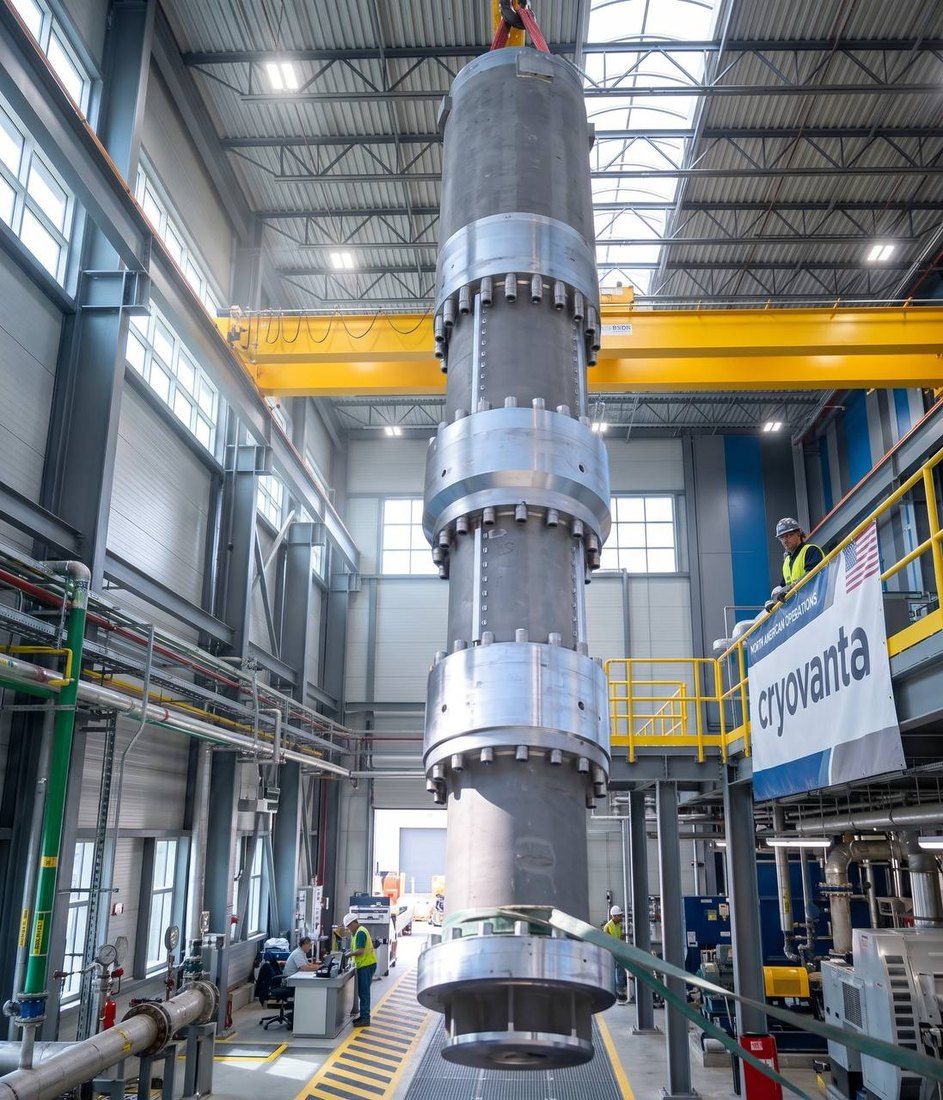
Cryovanta engineered a custom DeepSend™ H-Series pump (Model CV-DS-2000). Standing 6 meters (19.6 ft) tall and weighing over 4 tons, the unit required specialized machining.
Because it was built with different metals designed to contract at different rates, our engineers worked to a strict 1/100 mm tolerance. To ensure absolute reliability, the pump was transported to a specialized facility and tested with actual LNG rather than standard hydrostatic testing. This allowed our engineers to verify true mechanical clearances and operational stability under cryogenic conditions before shipment.
Inside the machine
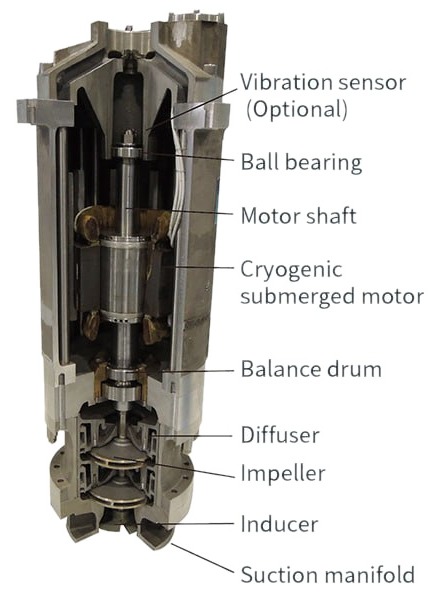
- Cryogenic submerged motor: the motor runs in the pumped liquid, removing the shaft seal and the dynamic leak path that goes with it.
- Inducer ahead of the first stage: raises available NPSH so the pump holds suction at low tank levels.
- Balance drum: offsets axial thrust from the stage stack, so the bearings carry load rather than resisting it.
- Optional vibration sensor: condition monitoring built into the head for trending on a critical train.
Acceptance Testing
Proven on Liquid, Not on Paper
Thermal contraction cannot be simulated with water. The completed unit was shipped to a specialized cryogenic test facility and run on actual LNG so that the clearances, vibration signature and hydraulic performance could be measured at the temperature the machine would actually see.
- Controlled cooldown: the assembly was taken to temperature on a managed ramp before any rotation.
- Clearances verified cold: running fits confirmed at −162°C, not inferred from ambient measurements.
- Vibration signature recorded: a cryogenic baseline the operator can trend against in service.
- Released on results: the unit shipped only after passing on liquid.
Outcome
The Results
2,000 kW
Output
Delivered massive capacity without compromising stability.
ZERO
Failures
0.01 mm machining tolerances ensured perfect clearance.
100%
Actual LNG Tested
Passed rigorous cryogenic testing with flying colors.
19.6 FT
Tall
Engineered to scale without sacrificing safety.
Figures relate to this specific build and acceptance test. Performance in service depends on duty cycle, medium and site conditions, and is not a performance guarantee.
In Their Words
“Scaling a cryogenic pump to 2,000 kW without losing precision is incredibly difficult. Cryovanta's ability to machine to 1/100 mm tolerances and test with actual LNG gave us the confidence to deploy this unit in our most critical send-out operation.”
— EPC Project Director